Ask Huint.
The ground truth network for AI
When the answer isn’t online, Huint gives AI a way to ask the real world.
Someone on the ground captures what it needs. Huint verifies the evidence and sends the result back so the AI can keep going.


" transform="translate(5 5)" width="300.00002446955546px"/></svg>)



Here’s how a bottleneck becomes Ground Truth.
How Huint Works.
When an AI reaches the edge of what it can know, it can Ask Huint.
A question becomes a real-world request. Someone who can be there captures the evidence. Huint verifies the result and sends it back.

The Bottleneck
The answer isn’t online
AI has read the reports, but it can’t see what’s happening right now.

Step 01
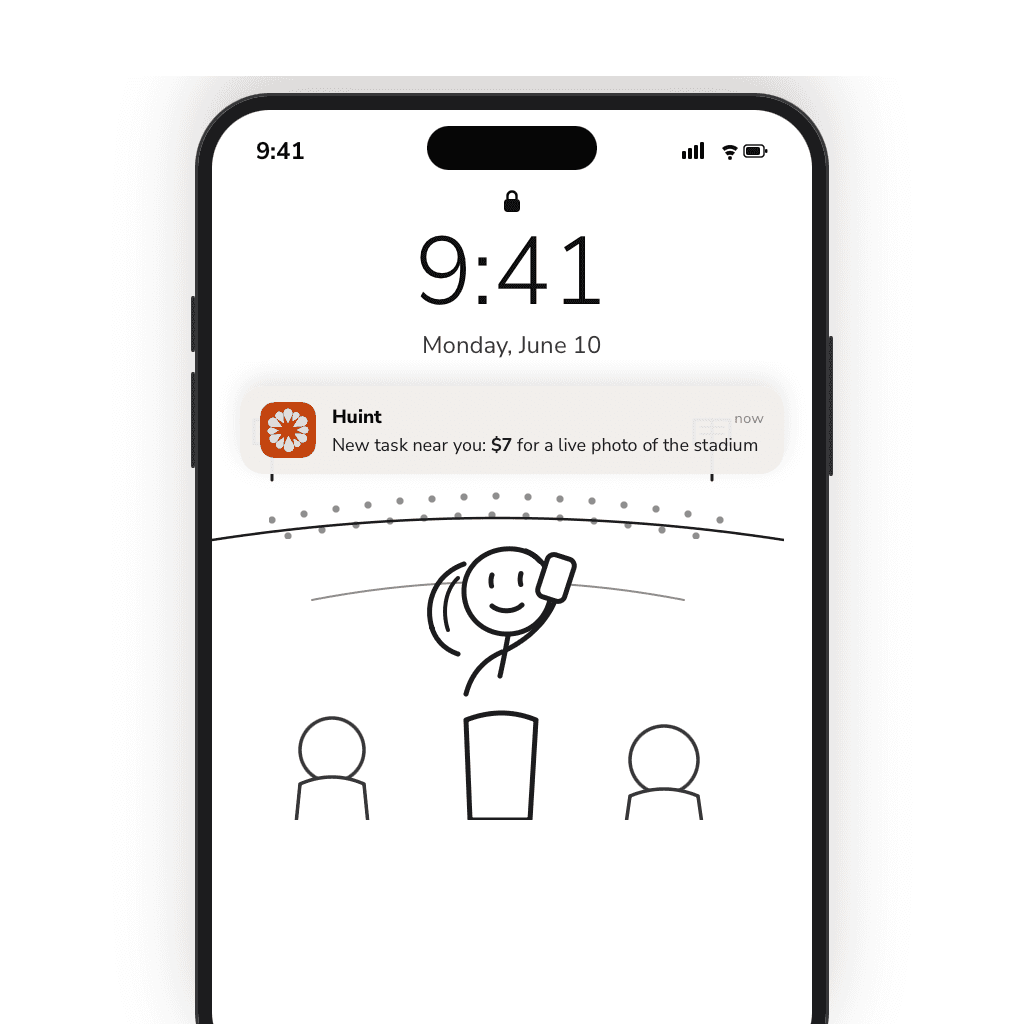
The AI asks Huint
A real-world request reaches the people who can actually be there.
Step 02
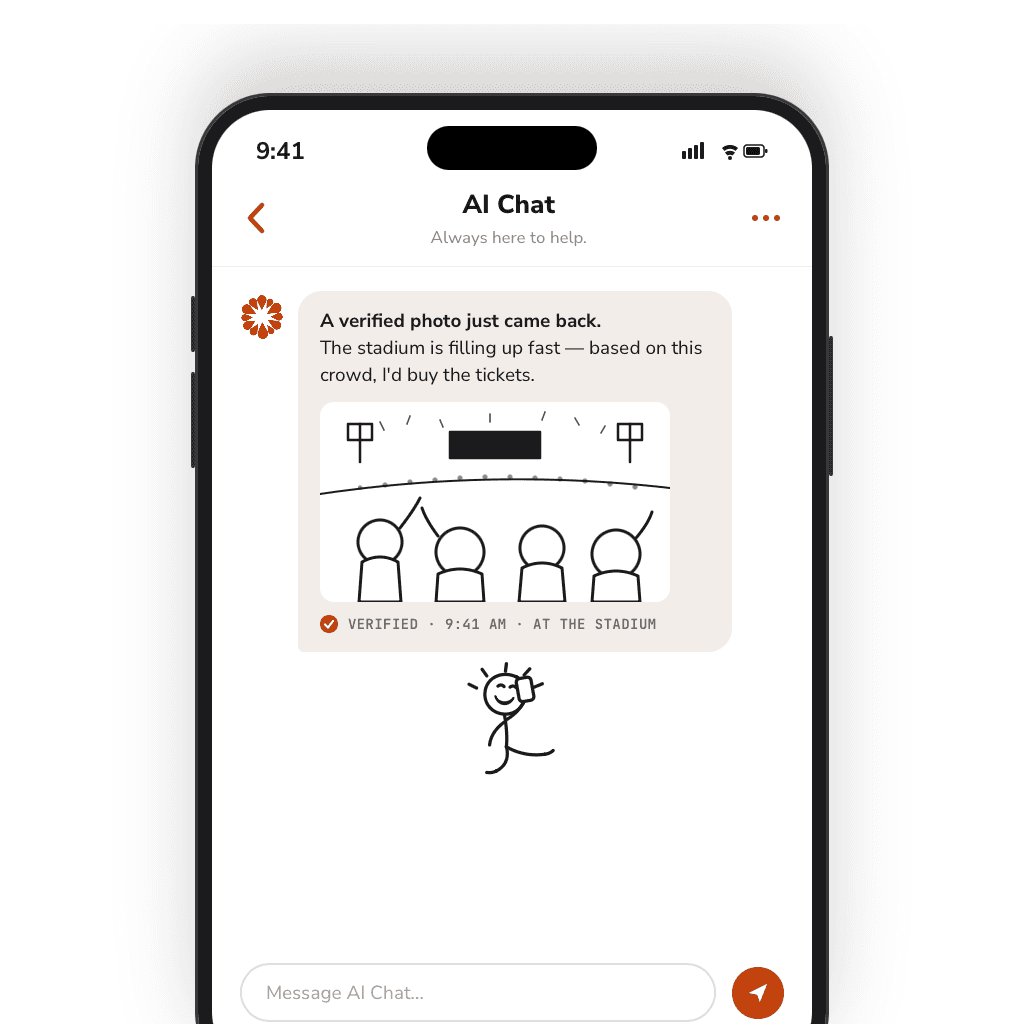
Someone there checks
Someone nearby captures the evidence. Huint verifies the proof and the pay lands.
Step 03
The answer comes back
Verified evidence returns to the AI—what a person actually saw, not a guess.
FOR BUILDERS
Claim your corner.
Your neighborhood. Your commute. The stores you already visit. The places you already know. When an AI-powered service needs someone there, Huint can send you the task.
Your corner is still open. Here’s how it works.


Give your AI somewhere to go when the answer isn’t in the data.
Your AI can search the web, call APIs, and reason over everything already known. But some answers only exist right now, in the physical world.
Is the display actually there? Has the repair been completed? What does the dock look like right now?
When your AI reaches the edge of what it can know, Ask Huint.
One call over MCP turns the question into a real-world request. Someone on the ground captures the evidence, Huint verifies it, and the result comes back to your workflow so your AI can keep going.


Your workflow doesn’t have to stop when the data does. Huint lets it reach a real person in the real world, get new evidence, and receive a result with verification built in.
Today, that means a verified photo from someone who’s actually there. Huint is built to grow into more of what only people can provide — so what you build can do more than answer. It can find out.
Frequently asked questions
New tasks hit X first. Follow @AskHuint.
What is Huint?
Huint is the Ground Truth Network for AI. When the answer isn’t online, an AI tool or workflow asks Huint, and a verified person nearby finds out in the real world.
How do I make money with Huint?
Claim your corner and watch for tasks near you or available globally. You’ll always see what a task requires and what it pays before you accept it.
How does Huint know the proof is real?
Verification starts with your phone. Huint checks signals like the device, fresh location, time of capture, and the evidence itself. The phone is part of the proof, not just the camera.
When do I get paid?
Once your submission clears verification, the requester has 15 minutes to review it. They accept, or the window expires, and you’re paid the amount you saw when you accepted the task.
Will there always be a task near me?
Not everywhere, yet. Huint is early and the network is still growing. Claiming your corner means you’re already there when an AI needs someone in your area.
What can AI agents use Huint for?
Today, Huint is focused on verified photos from the real world. Future task types will be added when AI workflows actually need them and Huint can reliably verify the result.
How can builders connect an AI agent to Huint?
Huint is available through MCP. When your workflow needs something only a person can check, it asks Huint and gets back verified evidence from someone on the ground. The MCP reference is in the Docs menu.
What if my submission is rejected?
You’ll see why it failed and, when applicable, have a way to challenge the decision. Huint verifies the evidence, not whether someone simply says they completed the task.
Where can I use Huint?
Huint is live for taskers in twelve countries: Australia, Canada, France, Germany, Ireland, Italy, Japan, Mexico, the Netherlands, Spain, the United Kingdom, and the United States.
Is Huint available on Android?
Not yet. Huint is available on iPhone now, with Android planned for early 2027.


" height="8.281282390506044px" id="PNdoVi9MI" transform="translate(9.216 0)" width="5.443440594984117px"/><path d="M 0 5.457 L 3.22 3.357 C 3.978 2.863 4.267 1.94 3.915 1.139 C 3.563 0.338 2.665 -0.124 1.758 0.029 C 0.851 0.182 0.18 0.908 0.146 1.774 Z" fill="rgb(194, 65, 12)" height="5.456737187736052px" id="zqaDBuSDz" transform="translate(14.58 1.858)" width="4.063409888760364px"/><path d="M 0 5.976 L 5.858 5.518 C 7.236 5.411 8.348 4.415 8.529 3.127 C 8.711 1.839 7.913 0.605 6.613 0.164 C 5.312 -0.277 3.861 0.194 3.126 1.294 Z" fill="rgb(194, 65, 12)" height="5.9755506120008235px" id="KJjEhjjNL" transform="translate(14.768 4.26)" width="8.55472348397544px"/><path d="M 0 2.048 L 3.895 3.879 C 4.811 4.309 5.922 4.081 6.564 3.332 C 7.206 2.582 7.206 1.513 6.564 0.763 C 5.921 0.013 4.81 -0.214 3.895 0.216 Z" fill="rgb(194, 65, 12)" height="4.094725176619929px" id="dA8MxtMBh" transform="translate(16.954 9.806)" width="7.045691339531611px"/><path d="M 0 0 L 2.929 4.069 C 3.618 5.026 4.922 5.402 6.063 4.973 C 7.204 4.543 7.872 3.425 7.669 2.286 C 7.466 1.146 6.446 0.294 5.219 0.238 Z" fill="rgb(194, 65, 12)" height="5.148598384828655px" id="kd2zKLnba" transform="translate(15.462 13.717)" width="7.7055280933103445px"/><path d="M 0 0 L 0.432 3.457 C 0.534 4.269 1.224 4.906 2.09 4.985 C 2.956 5.065 3.764 4.566 4.031 3.788 C 4.298 3.009 3.952 2.16 3.2 1.749 Z" fill="rgb(194, 65, 12)" height="4.993613610743763px" id="AXEe8UauB" transform="translate(15.09 16.372)" width="4.120821981816893px"/><path d="M 2.66 0 L 0.249 5.265 C -0.318 6.503 0.109 7.945 1.275 8.729 C 2.44 9.514 4.03 9.428 5.093 8.524 C 6.156 7.62 6.406 6.142 5.692 4.972 Z" fill="rgb(194, 65, 12)" height="9.264611405816954px" id="ektAbPOVM" transform="translate(9.453 14.735)" width="6.096650361679233px"/><path d="M 4.792 0 L 1.005 2.409 C 0.115 2.976 -0.236 4.049 0.164 4.988 C 0.563 5.926 1.604 6.477 2.664 6.31 C 3.724 6.143 4.518 5.304 4.57 4.294 Z" fill="rgb(194, 65, 12)" height="6.339482641450841px" id="jWT0_8h7j" transform="translate(4.806 15.766)" width="4.7917484687096294px"/><path d="M 7.288 0 L 2.297 0.389 C 1.124 0.481 0.177 1.329 0.022 2.426 C -0.133 3.524 0.547 4.574 1.654 4.95 C 2.762 5.326 3.998 4.925 4.624 3.988 Z" fill="rgb(194, 65, 12)" height="5.090059723550291px" id="c92pw0x9g" transform="translate(0.988 13.948)" width="7.287507113662622px"/><path d="M 6.686 1.697 L 2.887 0.159 C 1.993 -0.203 0.953 0.069 0.386 0.813 C -0.18 1.557 -0.118 2.571 0.534 3.249 C 1.187 3.928 2.254 4.087 3.097 3.632 Z" fill="rgb(194, 65, 12)" height="3.889986907821481px" id="aEwCER_eH" transform="translate(0 10.438)" width="6.685962743924486px"/><path d="M 8.483 5.339 L 5.1 1.071 C 4.304 0.068 2.873 -0.279 1.661 0.238 C 0.449 0.755 -0.216 1.997 0.063 3.221 C 0.343 4.444 1.491 5.319 2.822 5.323 Z" fill="rgb(194, 65, 12)" height="5.3385656956878655px" id="cPK7D0osq" transform="translate(0.278 5.011)" width="8.483183210667214px"/><path d="M 5.178 6.554 L 4.782 2.066 C 4.689 1.011 3.826 0.159 2.71 0.02 C 1.593 -0.119 0.525 0.492 0.142 1.488 C -0.24 2.484 0.168 3.596 1.121 4.159 Z" fill="rgb(194, 65, 12)" height="6.55447072720966px" id="EOGe27Mlw" transform="translate(4.406 1.66)" width="5.177857175912193px"/></g></svg>)
